


What is a Service Level Agreement for IT Support? The 2026 Strategic Guide

What if the document you currently view as a legal safety net was actually the strategic blueprint for your company’s next era of expansion? Many leaders find themselves asking what is a service level agreement for IT support when they're already facing the sting of unpredictable downtime or the exhaustion of deciphering technical jargon. It's difficult to scale when transparency feels like an afterthought and response times aren't aligned with your pace of innovation. You deserve a relationship built on quiet confidence and measurable excellence.
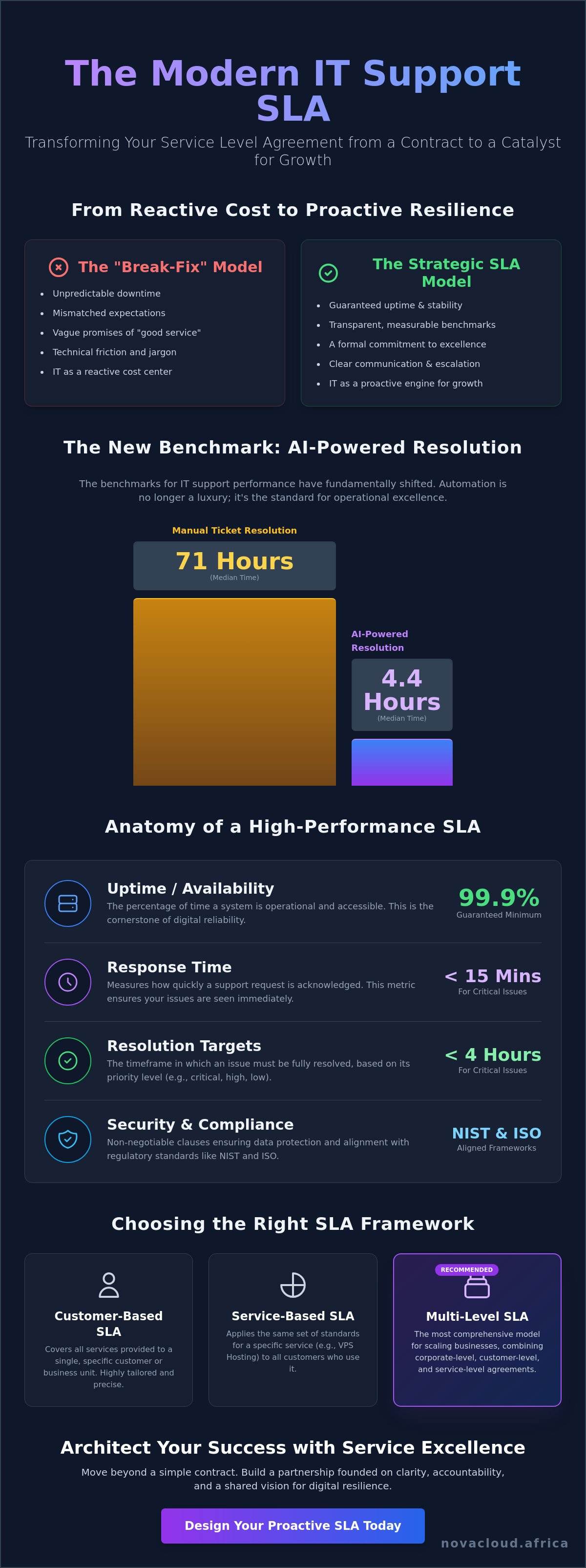
We'll show you how a well-architected SLA transforms technical support from a reactive cost into a proactive engine for digital resilience. With AI now resolving automated tickets in a median of 4.4 hours compared to 71 hours manually, the benchmarks for performance have fundamentally shifted. This guide previews the 2026 framework for guaranteed uptime, the rise of Experience Level Agreements (XLAs), and how to align your infrastructure with the latest NIST and ISO standards to ensure your digital evolution is in expert hands.
Key Takeaways
- Learn why a well-crafted SLA is more than a contract; it's a strategic blueprint that shifts your IT from a reactive cost to a driver of digital resilience.
- Understand exactly what is a service level agreement for IT support and how it provides a transparent framework for measuring performance and ensuring accountability.
- Identify the essential metrics, from response times to resolution targets, that act as the vital signs for your organization's mission-critical systems.
- Discover how to choose between customer-based and multi-level models to ensure your technical support architecture scales alongside your business evolution.
- Explore how proactive monitoring and clear escalation procedures eliminate the "experience tax" caused by unpredictable downtime and technical friction.
Demystifying the Service Level Agreement: A Foundation for ICT Excellence
In the high-velocity landscape of 2026, technology is no longer a utility; it's the very pulse of your organization. When leaders ask what is a service level agreement for IT support, they aren't just looking for a definition. They're seeking a guarantee of stability. A Service Level Agreement (SLA) is a formal commitment between a service provider and a client that moves beyond vague promises of "good service." It outlines specific, measurable benchmarks for service quality, availability, and mutual responsibilities. In the context of IT support, it serves as the roadmap for technical execution and absolute accountability. A Service Level Agreement is the cornerstone of professional ICT infrastructure management.
Think of the SLA as the architectural blueprint for your digital presence. It ensures that every stakeholder understands the standards of performance required to keep the wheels of industry turning. For a comprehensive overview of SLAs, it's clear that these documents have evolved from simple legal shields into proactive strategic tools. They illuminate the path toward digital maturity, providing a sense of renewal for businesses that have previously struggled with opaque technical support. It's about moving from a state of uncertainty to one of total clarity.
The Core Purpose of an IT Support SLA
Ambiguity is the enemy of progress. The primary purpose of an SLA is to eliminate the friction caused by mismatched expectations. By setting clear definitions for what constitutes a "critical" versus a "low" priority issue, you remove the guesswork from service delivery. This framework allows for measuring performance against objective data points, ensuring that your provider is judged on facts rather than feelings. Protection is also a key factor. A well-designed agreement includes defined remedies and escalation paths, ensuring that if a system falters, the route to restoration is already paved and ready for execution.
Why Business-Grade ICT Requires Formal Agreements
The transition from a reactive "break-fix" model to proactive managed infrastructure is what separates regional leaders from the rest. When you are safeguarding mission-critical Virtual Private Servers, you can't leave performance to chance. An SLA provides the rigorous oversight needed to maintain 99.9% uptime for cloud-based communications and high-performance applications. It ensures that your digital evolution is in expert hands, allowing your team to focus on growth while we handle the complexities of the underlying architecture. This commitment to excellence transforms IT support from a cost center into a catalyst for regional empowerment and business resilience.
The Anatomy of an IT Support SLA: Essential Metrics and Clauses
If the agreement is the blueprint for your digital house, then its metrics are the vital signs of your IT environment. These data points provide a real-time pulse on system health, ensuring that your digital infrastructure remains resilient and capable of supporting rapid growth. An authoritative perspective on the structure and benefits of SLAs highlights how these measurements protect the integrity of your operations. When defining what is a service level agreement for IT support, it's essential to view it as a living document that translates technical stability into business momentum. It's a commitment to clarity that allows leaders to breathe easier, knowing their systems are monitored with precision.
A robust agreement must include specific thresholds for response, resolution, and availability. These aren't just arbitrary numbers; they're the benchmarks of accountability. Uptime is the percentage of time a system remains operational and accessible. In a world where minutes of downtime can translate into significant missed opportunities, these percentages represent the reliability of your brand. Clauses regarding data security and compliance are also non-negotiable for modern enterprises, especially as new state privacy laws and NIST standards reshape the regulatory landscape in 2026.
Primary Performance Metrics to Monitor
- Response Time: This measures how quickly a technician acknowledges a support request. It's the first step in restoring order and maintaining trust.
- Resolution Time: This tracks the duration from the initial report to the final fix. With AI automation now resolving tickets in a median of 4.4 hours, expectations for speed have never been higher.
- System Availability: This ensures guaranteed uptime for Business Fibre and cloud services, keeping your team connected to the global marketplace.
Critical Legal and Operational Clauses
Escalation procedures provide a clear hierarchy of support for complex technical failures, ensuring that the right expertise is applied at the right time. Service credits act as financial remedies, provided if service levels aren't met, which aligns the provider's success directly with your own. Finally, exclusions clearly define what isn't covered, preventing service gaps and ensuring that both parties understand the boundaries of the partnership. Aligning these technical details with your strategic goals ensures your digital evolution remains on a steady, upward trajectory.
Navigating SLA Frameworks: Customer, Service, and Multi-Level Models
Structural integrity is the silent partner of digital growth. While the metrics we explored previously provide the data, the framework provides the context, ensuring that every layer of your organization receives the exact intensity of support it requires. Determining what is a service level agreement for IT support for your specific context means selecting an architectural framework that mirrors your business structure. Not all SLAs are created equal; the architecture must match the organizational complexity to be effective. Choosing the right model ensures that your technical support scales alongside your digital evolution, preventing the friction that occurs when a growing business outpaces its legacy contracts.
The choice of framework dictates the cadence of support and reporting. It defines how information flows from the server room to the boardroom, creating a transparent relationship built on quiet confidence. By aligning the contract structure with your operational reality, you transform a standard document into a catalyst for regional empowerment. This strategic alignment ensures that technology remains an enabler of progress rather than a source of confusion.
Service-Based vs. Customer-Based SLAs
A service-based SLA provides uniform support levels for all users of a specific tool or platform. This is highly efficient for standardized infrastructure, such as Hosted PBX systems, where every employee requires the same high standard of connectivity and voice clarity. In contrast, a customer-based SLA is a tailored agreement designed for the unique needs of a single organization. It covers all services used by that client under one bespoke umbrella. While standardized services offer streamlined efficiency, bespoke support provides the precision needed for complex, one-of-a-kind digital architectures.
The Multi-Level SLA: A Comprehensive Approach
For diverse enterprise needs, the multi-level SLA offers the most sophisticated approach. It avoids redundancy by layering responsibilities across three distinct tiers. The Corporate Level establishes broad standards that apply to every user in the organization, ensuring a baseline of excellence. The Customer Level addresses specific requirements for particular departments or business units, such as the increased security needs of a finance team. Finally, the Service Level focuses on detailed performance targets for individual high-impact technologies. This tiered strategy ensures that the most critical systems receive the most intense focus, providing a sense of renewal and clarity across the entire enterprise architecture.
Beyond the Contract: How SLAs Drive Operational Resilience and ROI
An SLA is more than a defensive document; it's a strategic asset designed to minimize the "experience tax" of failing software. When systems lag or connections drop, your team pays this tax in lost productivity and mounting frustration. Understanding what is a service level agreement for IT support requires viewing it as a catalyst for business growth rather than a mere cost of doing business. By mandating proactive monitoring, an SLA ensures that technical friction is identified and resolved before it can disrupt your workflow. It creates a predictable environment where your digital evolution can flourish without the shadow of unexpected failure.
Strategic IT Assistance backed by a rigorous SLA reduces the total cost of ownership by replacing expensive emergency repairs with predictable, managed oversight. This shift allows for more accurate budgeting and resource allocation. It moves your organization away from the chaos of reactive maintenance toward a future of sustained technical authority. Aligning your IT support with your broader business goals ensures that every technical benchmark serves a specific commercial outcome.
Mitigating Risk with Proactive Support
Security is the bedrock of modern resilience. SLAs enforce the regular security audits and Managed Firewall updates required to stay compliant with the NIST Cybersecurity Framework 2.0. These agreements also dictate the speed of disaster recovery, ensuring that business continuity isn't just a goal, but a guaranteed outcome. In 2026, documenting these service levels is essential for meeting national data protection standards and protecting your brand's reputation in a fragmented regulatory landscape. It gives your stakeholders the reassurance that their data is handled with the highest degree of professional care.
Quantifying the Value of Technical Authority
The return on investment for a well-architected SLA is found in the numbers. Consider the impact of response times on your bottom line; research shows that companies responding to leads in under five minutes have a 32% close rate, compared to just 12% for those taking over 24 hours. A guaranteed response time doesn't just fix a printer; it secures your revenue stream. Beyond the data, there's the psychological benefit of "quiet confidence." Knowing your digital infrastructure is in expert hands allows your leadership to focus on visionary expansion. Transparent reporting fosters a collaborative partnership, moving beyond a simple vendor relationship toward a shared mission of regional progress. Secure your digital future with a partner who understands the value of resilience.
Architecting Your Success: The NovaCloud Approach to Service Excellence
NovaCloud Africa provides more than just IT assistance. We act as strategic architects for your ICT, designing systems that don't just function but flourish. Understanding what is a service level agreement for IT support is the foundation of a professional partnership, but the execution of that agreement is where true digital transformation begins. We combine technological authority with a human-centric focus on your organization's progress, ensuring that every technical metric is tethered to a tangible business outcome. Our commitment is to provide the quiet confidence you need to lead your industry with visionary optimism.
We view every client relationship as a collaborative alliance. Experience the clarity of business-grade cloud infrastructure backed by support that anticipates challenges before they disrupt your rhythm. This proactive stance ensures that your digital evolution never loses momentum, even as the global landscape becomes more complex. By choosing a partner that prioritizes stability and expansion, you empower your team to focus on what they do best while we handle the intricacies of your technical architecture.
Integrated Support for Cloud and Connectivity
Our approach involves seamless SLA management across Cloud Infrastructure and security protocols. This integration ensures that your data remains accessible and protected under a unified standard of excellence. We provide specialized support for Hosted PBX and high-performance VoIP hardware, such as the Yealink T31P IP Phone, creating a cohesive communication environment. Proactive monitoring is woven into the fabric of our service, ensuring that your connectivity remains robust and your applications stay responsive. This holistic oversight eliminates the service gaps that often plague organizations dealing with multiple, disconnected vendors.
Partnering for the Future
We tailor our service levels to match your specific enterprise growth roadmap. This isn't a one-size-fits-all solution; it's a bespoke strategy designed to scale alongside your ambitions. Our expert technical executors are deeply knowledgeable about the global landscape while remaining passionately committed to the specific needs of our primary regional market. This local expertise, combined with international benchmarks, creates a unique market position that benefits every organization we serve. We take pride in being an enabler of regional progress, providing the tools and support necessary for a fresh start in business efficiency. Get started today by contacting our strategic ICT advisors to architect a resilient future for your organization.
Forging a Future of Uninterrupted Innovation
Transformation begins when you stop reacting to technical friction and start architecting for resilience. We've explored how specific metrics and multi-level frameworks turn a simple contract into a powerful engine for business stability. Understanding what is a service level agreement for IT support is the first step toward reclaiming your operational focus and ensuring your systems scale alongside your ambitions. By prioritizing proactive monitoring and clear accountability, you eliminate the uncertainty that often hinders regional expansion.
As a sophisticated South African ICT provider, we specialize in business-grade cloud infrastructure and comprehensive Managed Firewall solutions that protect your digital borders. Our expertise ensures your evolution is handled with quiet confidence and technical authority. Don't let your progress be taxed by unpredictable downtime. Architect your resilient ICT future with NovaCloud's expert IT Assistance and experience the renewal of a transparent, growth-oriented partnership. The possibilities for your organization are limitless when your foundation is secure.
Frequently Asked Questions
What is the difference between an SLA and an OLA?
An SLA is the external agreement between you and your provider, while an Operational Level Agreement (OLA) is the internal document that defines how technical teams collaborate to meet those external goals. Think of the SLA as the promise made to the boardroom and the OLA as the tactical instructions for the engineering floor. Both are essential for maintaining the rhythmic flow of a high-performance digital environment and ensuring accountability at every level.
How do I measure SLA compliance for my IT support?
Compliance is measured through automated monitoring tools and ITSM platforms that track real-time performance against your agreed benchmarks. Leading organizations typically aim for a 92% compliance rate as a sign of healthy, resilient infrastructure. By reviewing these dashboards monthly, you gain total clarity on whether your provider is meeting the resolution and response targets defined in your strategic guide to what is a service level agreement for IT support.
What happens if my IT provider misses an SLA target?
When a target is missed, the provider initiates a formal escalation and root cause analysis to prevent the failure from recurring. This process identifies whether the issue was a one-off anomaly or a systemic weakness in the ICT architecture. Depending on the contract, repeated misses may trigger service credits. These act as a financial remedy to align the provider's performance with your business growth and reassure you that your systems are in expert hands.
Can an SLA be changed after the contract is signed?
An SLA is a living document that can and should be updated through a formal change management process as your organization evolves. If you migrate to new cloud infrastructure or expand your regional reach, your support requirements will naturally shift. Regular amendments ensure that your technical support remains a catalyst for progress rather than a legacy constraint. It's about keeping your digital evolution aligned with your current operational reality.
How much does an IT support SLA typically cost?
The cost of an agreement varies based on the complexity of your environment and the intensity of the support required. Rather than a flat fee, it's often structured around the criticality of your systems and the speed of response you demand. While costs differ across the industry, the investment should always be weighed against the potential loss of revenue from unpredictable downtime and the experience tax on your employees' productivity.
Is an SLA necessary for a small business with only a few employees?
Even for small teams, an SLA is vital because it replaces best effort promises with a professional commitment to performance. Without one, your business is at the mercy of your provider's current workload rather than your own mission-critical needs. Establishing what is a service level agreement for IT support early in your journey ensures that your digital foundation is built for expansion and quiet confidence from day one.
What are 'Service Credits' in an IT support context?
Service credits are financial rebates provided by the ICT partner if they fail to meet the performance thresholds outlined in the agreement. They serve as a mechanism of accountability, ensuring that the provider shares the risk of downtime or slow resolution. This structure reinforces a collaborative partnership where the provider is financially incentivized to maintain the highest standard of digital resilience and visionary support for your organization.
How often should an SLA be reviewed and updated?
You should review your SLA at least once a year or whenever a significant change occurs in your digital landscape. Major transitions, such as moving to a new managed firewall or upgrading your business fibre, require updated benchmarks to remain relevant. These reviews provide a fresh start for business efficiency, ensuring your support framework stays aligned with the latest international benchmarks and your specific regional expansion goals.
