


Business VoIP Call Quality Troubleshooting: Architecting Crystal-Clear Communication

A dropped call isn't just a technical glitch; it's a silent erosion of the trust you've built with your clients. You've likely experienced the frustration of a conversation that clips and echoes, leaving remote teams disconnected and professional impressions compromised. While many settle for surface-level resets, true communication excellence requires a more intentional approach. This is why business VoIP call quality troubleshooting must evolve from a reactive chore into a strategic design of your digital environment.
It's time to move past the uncertainty of choppy audio and toward a future-proof network that empowers your regional growth. In this guide, you'll learn how to master the technical triad of jitter, latency, and packet loss, aiming for that ideal sub-150 millisecond latency threshold that defines elite voice quality. We'll preview the essential steps to architect a resilient voice landscape, ensuring your infrastructure, from managed firewalls to symmetrical business fibre, serves as a clear conduit for your organization's vision and brings a renewed clarity to every connection you make.
Key Takeaways
- Learn to move beyond "functional" audio by understanding the Mean Opinion Score (MOS) and how it benchmarks true enterprise-grade clarity.
- Identify the root causes of choppy conversations by mastering business VoIP call quality troubleshooting techniques to eliminate jitter, latency, and packet loss.
- Discover why symmetrical Business Fibre is the essential foundation for stable voice traffic, outperforming best-effort residential connections in reliability.
- Implement high-impact restoration steps, including Quality of Service (QoS) rules and hardware audits, to ensure your IP handsets deliver peak performance.
- Architect a resilient communication environment using Hosted PBX to unify remote teams and provide the stability needed for organizational growth.
Defining the Standard: What Constitutes Business-Grade VoIP Quality?
In the architecture of modern enterprise, voice communication has evolved from a simple utility into a high-stakes performance metric. Many organizations operate under the misconception that "functional" audio is sufficient for daily operations. However, as digital landscapes expand, the gap between basic connectivity and exceptional clarity becomes a defining factor in competitive advantage. Achieving this standard requires more than just luck. It necessitates a deep dive into business VoIP call quality troubleshooting to ensure every interaction feels as immediate and impactful as a face-to-face meeting.
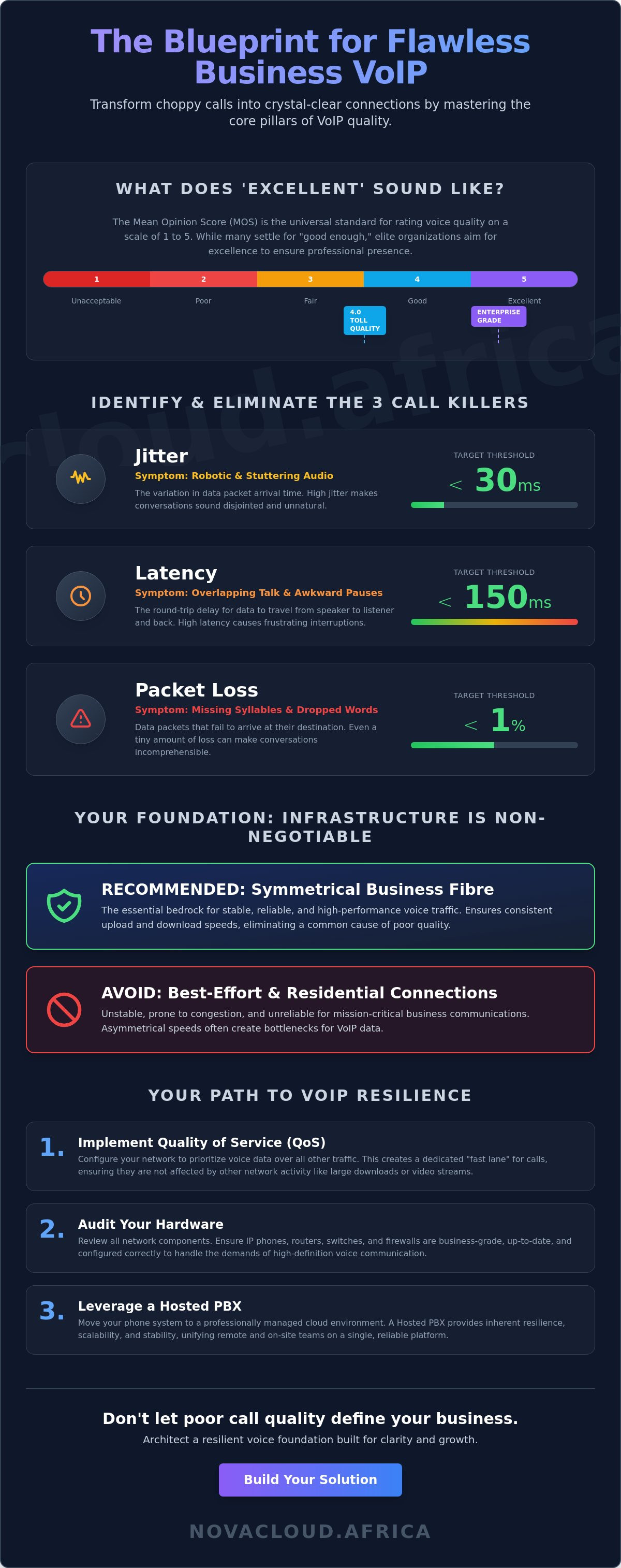
We measure this excellence through the Mean Opinion Score (MOS), a standardized benchmark that rates voice quality on a scale from 1 to 5. While a score of 4.0 is often cited as the industry standard for "toll quality," visionary businesses aim higher. They recognize that call quality acts as a silent ambassador for their brand professionalism. When a client hears crystal-clear audio, they perceive a stable, high-functioning organization. When they encounter jitter or echoes, that confidence wavers. This is why mastering Quality of Service (QoS) is not just a technical task; it's a strategic imperative that supports Unified Communications and drives long-term growth.
The Psychology of Sound in Business
Audio clarity does more than just transmit words. It manages the cognitive load of your team and your clients. During high-stakes negotiations, any audio degradation forces the brain to work harder to decode speech. This increases fatigue and reduces the brain's capacity to process complex information. For remote teams, consistent clarity fosters a sense of presence and cohesion that "good enough" systems cannot replicate. By prioritizing high-definition voice, you establish a motif of renewal and fresh starts, signaling to your market that your infrastructure is built for precision and reliability.
VoIP vs. Legacy Systems: A Strategic Comparison
The era of traditional copper lines is rapidly fading. As of early 2026, regulatory shifts like the FCC’s modernization orders are accelerating the replacement of legacy services with modern alternatives. Legacy systems lack the intelligence and scalability required for modern enterprise expansion. In contrast, Hosted PBX systems offer a dynamic architecture that grows with your organization. This transition represents a catalyst for regional empowerment. By moving away from rigid physical infrastructure, businesses gain the territorial reach and flexibility needed to thrive in a globalized economy, ensuring that business VoIP call quality troubleshooting remains a manageable, proactive part of their digital evolution.
The Technical Triad: Jitter, Latency, and Packet Loss
To achieve a truly resilient voice environment, you must look beyond the surface of a dial tone. We envision a network where data flows with the purity of celestial light, unhindered by the friction of poor configuration. This clarity depends on mastering three technical pillars: jitter, latency, and packet loss. When these elements are out of sync, the resulting audio degradation disrupts the rhythm of your business. Mastering business VoIP call quality troubleshooting is therefore an essential skill for any modern ICT leader who values precision and professional presence.
Jitter is the variance in packet arrival time. In an ideal 2026 environment, jitter must remain below 30 milliseconds to prevent the stuttering, robotic sound that plagues unoptimized systems. Latency, the "round-trip" delay, should stay under 150 milliseconds for high-definition performance. Once it crosses the 300-millisecond mark, conversations become a frustrating cycle of overlapping talk and awkward silences. Finally, packet loss is the most unforgiving of the triad. Even a 1% loss can cause syllables to vanish, forcing participants to repeat themselves and stalling the momentum of high-stakes meetings.
Diagnosing the Root Cause
Identifying where the breakdown occurs is the first step toward restoration. A simple ping test can reveal much about your network stability, helping you differentiate between internal congestion and external ISP bottlenecks. While the FCC guide to VoIP highlights that external factors like provider outages can impact service, many quality issues originate within the local area network. Understanding these nuances allows you to act with precision rather than guesswork, ensuring your digital evolution remains on a steady, upward trajectory.
The Impact of Network Congestion
Modern offices are busy digital ecosystems. Large file transfers to cloud backups or high-definition video streaming can easily "starve" voice traffic if the network architecture is not properly balanced. Voice packets are small and time-sensitive; they cannot wait in line behind a massive data download. By implementing a multi-layered monitoring strategy, you can identify performance dips before they impact a client call. Ensuring your digital infrastructure is correctly mapped to prioritize these critical voice streams is the key to maintaining a professional edge in a competitive regional market. This proactive stance transforms your network from a simple utility into a powerful catalyst for growth.
Infrastructure Audit: Symmetrical Fibre vs. Best-Effort Connectivity
The foundation of any high-performance voice environment isn't just the software you choose, but the physical architecture that carries your data. While residential-grade connections might suffice for casual browsing, they often fail the rigorous enterprise reliability test required for consistent voice clarity. Transitioning to a dedicated Business Fibre solution provides the symmetry and stability that modern organizations demand. In the context of business VoIP call quality troubleshooting, identifying an asymmetrical or oversubscribed link is often the first step toward a permanent resolution.
As the Federal Communications Commission guide to VoIP explains, the quality of your internet connection is the primary driver of call performance. Unlike best-effort residential lines, symmetrical fibre ensures that your upload speed matches your download speed. This is vital because voice communication is a two-way stream; your outgoing audio requires just as much stability as the incoming signal. Without this symmetry, your voice packets often struggle for bandwidth against background data, leading to the choppy audio and dropped syllables discussed in our technical triad analysis.
Managed Firewalls act as the intelligent gatekeepers of this digital perimeter. They provide a sophisticated layer of protection that ensures your data remains secure without throttling the performance of your voice traffic. By architecting a network that balances high-speed throughput with robust security, you create an environment where communication can flourish. This strategic approach moves your business away from the uncertainty of legacy setups and toward a visionary standard of digital excellence.
The LTE Limitation
Relying on LTE or 5G for mission-critical PBX traffic introduces variables that are often beyond your control. Tower congestion during peak hours and even atmospheric weather conditions can cause sudden spikes in jitter and latency. These wireless links are inherently "best-effort," meaning they lack the dedicated pathing and guaranteed uptime of fixed fibre. For a growing business, the risk of a dropped call during a high-stakes negotiation is too great. Moving to dedicated infrastructure represents a fresh start, providing the regional empowerment and reliability your team needs to succeed.
Network Hardware Synergy
True resilience is achieved when your hardware works in perfect synergy. Optimizing Ubiquiti networks allows for seamless data handovers and robust signal coverage across your entire facility. This ensures that whether a staff member is at their desk or moving through a hybrid office, their connection remains steadfast. Furthermore, deploying FortiNet infrastructure allows your Managed Firewall to hunt for cyber threats in real-time while preserving strict QoS rules. This multi-layered approach ensures that your business VoIP call quality troubleshooting efforts result in a permanent, high-definition communication landscape.
Actionable Troubleshooting: A Step-by-Step Restoration Guide
Restoring clarity to your communication environment requires a methodical, layered approach. When you encounter audio degradation, the first step is implementing Quality of Service (QoS) rules on your router. This ensures that time-sensitive voice packets are prioritized over bulk data transfers. Without these rules, your voice traffic competes with large file downloads, leading to the jitter and latency issues we analyzed previously. By architecting a "VIP lane" for your voice data, you ensure that every syllable arrives with the precision your brand demands.
Next, conduct a hardware health check on your IP handsets. High-quality devices like the Yealink T31P are designed for enterprise precision, but they still require regular firmware updates to maintain peak performance. Audit your local cabling and Power over Ethernet (PoE) stability. A frayed Cat6 cable or an underpowered PoE switch can cause intermittent power drops, leading to sudden call disconnects or static. Finally, review your SIP ALG settings. SIP Application Layer Gateway (ALG) is often the silent killer of VoIP connections, modifying data packets in ways that cause one-way audio or registration failures. Disabling this feature is a critical step in business VoIP call quality troubleshooting.
For organizations facing persistent, complex issues that defy basic resets, engaging strategic IT assistance for deep-packet analysis can uncover hidden network bottlenecks. This level of technical execution moves beyond surface-level fixes, providing a permanent resolution that empowers your regional growth. If you are ready to stabilize your digital voice environment, you can audit your current ICT infrastructure with an expert partner today.
Hardware Focus: The Yealink Advantage
The Yealink T31P IP Phone serves as a cornerstone of reliable office communication. By keeping firmware current, you unlock the latest noise-reduction algorithms and security patches. These devices allow you to fine-tune acoustic shield settings, which effectively mask background office chatter, ensuring your voice remains the sole focus of the conversation. Investing in such specialized hardware drastically reduces the frequency of business VoIP call quality troubleshooting sessions by providing a stable, high-fidelity endpoint that resists ambient interference.
Router and Firewall Fine-Tuning
Effective troubleshooting also involves logical network segmentation. Configuring VLANs to isolate voice traffic from general guest or employee data prevents internal congestion from impacting call clarity. Additionally, ensure your firewall rules are architected to allow necessary UDP ports for your Hosted PBX environment. By precisely defining these pathways, you create a secure yet unhindered flow for your digital voice infrastructure. This proactive configuration prevents the "starvation" of voice packets and ensures your Managed Firewall supports, rather than hinders, your visionary communication goals.
Architecting Resilience with NovaCloud Hosted PBX
True communication resilience is not found in a series of patches; it's found in the deliberate architecture of your systems. While business VoIP call quality troubleshooting often begins as a reaction to failure, it should conclude with the implementation of a foundation built for expansion. NovaCloud Hosted PBX provides this foundation. It transforms your voice environment from a fragmented collection of hardware and links into a unified, centrally managed ecosystem. This cloud-first approach ensures that whether your team is in a central office or distributed across the region, their connection remains as clear and reliable as the celestial light that inspires our vision for digital renewal.
By integrating high-performance Yealink T31P handsets with our dedicated Business Fibre and FortiNet security, we create a single, cohesive environment where every component is optimized for voice. This synergy eliminates the uncertainty of "best-effort" setups. Our local ICT experts act as your strategic allies, providing the quiet confidence that your infrastructure is managed by hands that understand the specific needs of your market. This mission-driven focus ensures that your digital evolution is not just a technical upgrade, but a catalyst for regional empowerment and sustained professional growth.
The Future of Unified Communications
Modern business demands a digital workspace that is both fluid and secure. Moving beyond legacy limitations means adopting a visionary approach where your phone system, messaging, and collaboration tools exist in harmony. By integrating Microsoft 365 Business Licensing into your Hosted PBX environment, you create a seamless workflow that scales alongside your ambitions. This architecture supports the hybrid models of the future, allowing you to add users or territorial locations without the friction of traditional hardware constraints. It is a fresh start for your corporate efficiency, ensuring your team stays focused on innovation rather than infrastructure.
Your Next Steps to Clarity
The journey toward crystal-clear communication begins with a clear understanding of your current state. Conducting a comprehensive audit of your network metrics allows you to identify exactly where your current business VoIP call quality troubleshooting efforts should be directed. Partnering with a strategic ICT provider removes the technical uncertainty that often stalls progress, replacing it with a roadmap for long-term stability. If you are ready to move from a state of frustration to one of readiness, we invite you to discover the clarity of NovaCloud Hosted PBX. Together, we can architect a communication landscape that reflects the true professionalism and potential of your organization.
A Vision for Resilient Enterprise Communication
Excellence in voice communication isn't a luxury; it's the foundation of your organization's digital evolution. We've explored how moving beyond "best-effort" setups toward an intentional architecture eliminates the friction of dropped calls and poor audio. By mastering business VoIP call quality troubleshooting, you transition from reactive fixes to a state of quiet confidence in your ICT infrastructure.
This journey is anchored by the synergy of high-precision Yealink T31P hardware and the stability of national symmetrical Business Fibre. When backed by the robust protection of a Managed Firewall and FortiNet security, your voice traffic flows with the purity of celestial light. You are no longer just managing a network; you are designing a catalyst for regional empowerment. It's time to embrace a fresh start where every connection strengthens your brand. Architect your business voice with NovaCloud Hosted PBX and lead your team into a future of limitless potential.
Frequently Asked Questions
Why is my VoIP call audio cutting in and out?
Audio cutting in and out is typically caused by packet loss or high jitter on your local network. When data packets arrive out of order or fail to reach their destination, your IP phone can't reconstruct the sound smoothly. This is a primary focus during business VoIP call quality troubleshooting, where we aim for jitter levels below 30 milliseconds to maintain professional clarity.
Can my firewall settings affect my business VoIP call quality?
Your firewall settings are a primary factor in voice quality because they control how data packets move through your perimeter. If a firewall isn't correctly configured to prioritize UDP traffic or if it's blocking essential ports, you'll experience dropped calls or registration failures. Utilizing a Managed Firewall ensures your security protocols protect your data without throttling your communication.
Is a fibre connection mandatory for high-quality VoIP?
Symmetrical Business Fibre isn't strictly mandatory, but it's the only way to guarantee the stability required for enterprise-grade communication. Unlike best-effort residential links or wireless LTE, fibre provides the consistent upload and download speeds needed for high-definition voice. It eliminates the variables of weather and tower congestion, providing a resilient foundation for your digital evolution.
What is the ideal internet speed for a 10-person VoIP office?
A 10-person office should plan for at least 1 megabit per second of dedicated, symmetrical bandwidth for voice traffic alone. While voice packets are small, they require a clear path. In a modern office environment, a 300 Mbps symmetrical fibre plan is a common benchmark to ensure that background data transfers don't interfere with your team's ability to connect with clients.
How do I fix one-way audio issues on my IP phone?
One-way audio issues are frequently traced back to a router feature called SIP ALG or complex Network Address Translation (NAT) configurations. SIP ALG often incorrectly modifies voice packets as they pass through the router, causing one side of the conversation to drop. Disabling this feature is a standard step in business VoIP call quality troubleshooting to restore bidirectional clarity.
Does using Wi-Fi for VoIP phones cause call quality problems?
Yes, Wi-Fi is a common source of call quality problems due to its susceptibility to signal interference and physical obstructions. Wireless connections are "half-duplex," meaning they can't send and receive data simultaneously with the same efficiency as a wired cable. For mission-critical communication, we recommend using wired Ethernet and Ubiquiti networks to ensure seamless handovers and stability.
What is QoS and why does my business need it for voice calls?
Quality of Service (QoS) is a networking technology that prioritizes voice traffic over other types of data like emails or file downloads. Because voice communication happens in real-time, it can't tolerate the small delays that other data can. Implementing QoS ensures your Hosted PBX traffic always has the "right of way," maintaining a professional edge even when your network is busy.
Can I use my existing router for a professional Hosted PBX system?
While you can use an existing router, consumer-grade hardware often lacks the advanced features needed to support a professional Hosted PBX system. Enterprise-grade routers allow for the configuration of VLANs and robust QoS rules that prevent audio degradation. Upgrading to managed hardware ensures your network can scale alongside your business ambitions without the risk of technical uncertainty.
