
NovaCloud News
POPIA Compliance Evidence Through Real-Time Network Telemetry
Discover how Gauteng directors present concrete POPIA Section 19 technical evidence using real-time network monitoring, business fibre, and LTE failover.
29 September 2026 · NovaCloud Africa editorial team
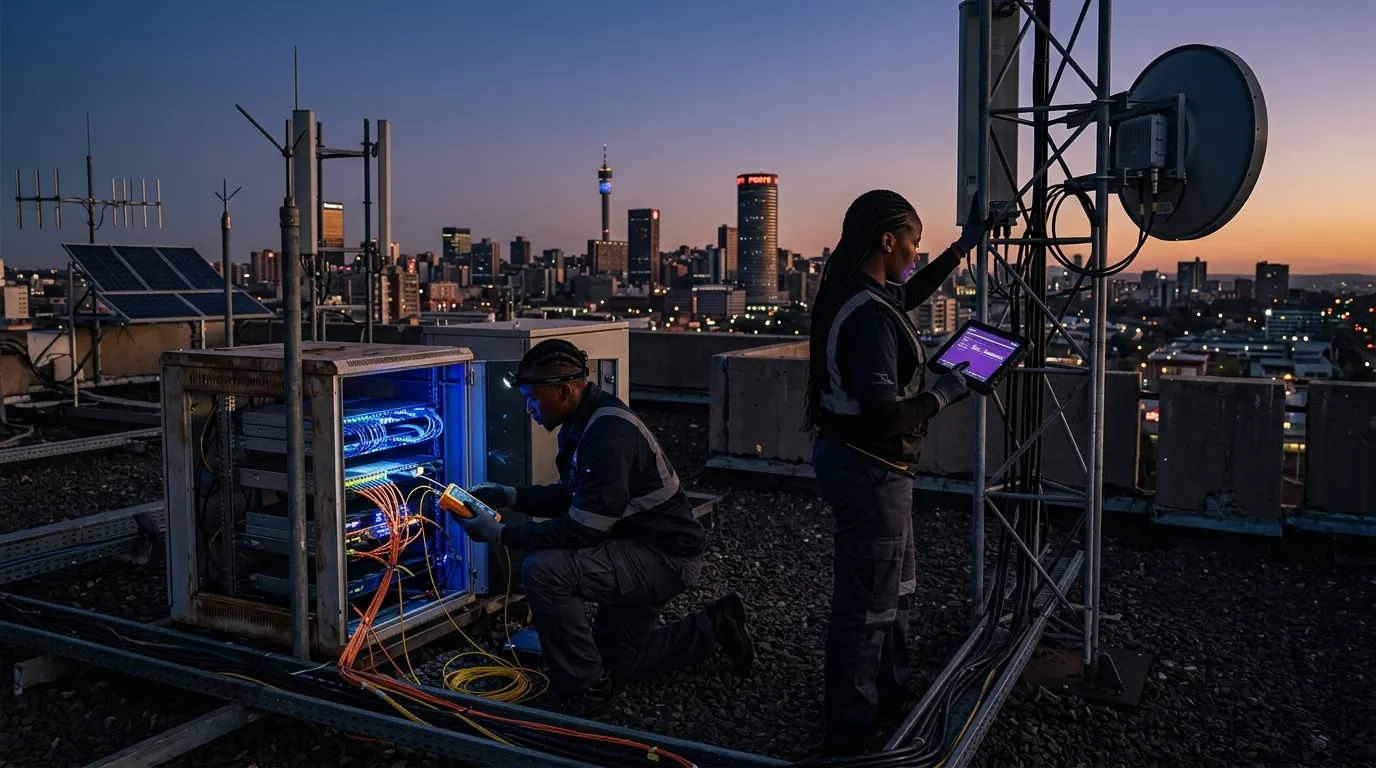
When an auditor, cyber-insurance underwriter, or board committee asks a company director for proof of data protection under South Africa's Protection of Personal Information Act (POPIA), handing over a 40-page binder of static IT policies is no longer enough. While policy manuals define intention, they provide zero evidence of operational reality. When main line infrastructure fails, unmonitored internet connections leave corporate networks vulnerable to data leakage, unauthorized ad-hoc tethering, and blind spots in threat visibility.
For mid-market firms and growing enterprises across Gauteng, true compliance lies in verifiable infrastructure performance. Directors must be able to demonstrate that reasonable technical measures—as defined by Section 19 of POPIA—are actively running across their connectivity layers. By combining primary business fibre in Gauteng with licensed microwave links, automated LTE failover, and continuous telemetry, South African organisations convert theoretical compliance into an immutable, auditor-ready record.
Section 19 Demands Operational Proof, Not Bound Binders
Section 19 of the Protection of Personal Information Act explicitly mandates that responsible parties must secure the integrity and confidentiality of personal information in their possession or under their control. The statute requires taking "appropriate, reasonable technical and organisational measures" to prevent loss of, damage to, or unauthorized destruction of personal information, as well as unlawful access.
As guidance from the Information Regulator South Africa emphasizes, compliance is an active operational state rather than a static administrative exercise. When a main fibre trench is severed by municipal earthworks in Highveld or Midrand, a written policy cannot secure employee traffic. If the secondary backup connection is unmonitored or requires manual intervention, staff frequently bypass corporate security controls by tethering corporate laptops to unencrypted personal mobile hotspots. This single action immediately exposes regulated data to interception and breaks the chain of custody.
Demonstrating compliance to a regulator or board requires showing that your network infrastructure automatically detects disruptions, maintains encrypted traffic pathways, and logs every state change in real time without human error.
Multi-Path Architecture: Fibre, Microwave, and LTE Failover
Achieving always-on connectivity while upholding stringent security standards demands a multi-path WAN architecture designed for automatic failover. Relying on a single fibre drop—regardless of SLA tier—exposes the business to severe physical disruption from cable cuts, power interruptions at roadside cabinets, or localized infrastructure failures.
A resilient Gauteng network environment relies on three complementary connectivity layers, managed under unified telemetry:
- Primary Terrestrial Fibre: High-throughput, symmetric business fibre providing low-latency backhaul to cloud workloads, hosted PBX nodes, and central data repositories.
- Licensed Microwave Backhaul: Dedicated high-frequency wireless links operating on licensed spectrum regulated by the Independent Communications Authority of South Africa (ICASA), providing line-of-sight path diversity immune to civil trenching damages.
- Automated LTE Failover: Carrier-diverse wireless failover routes configured on edge firewalls to maintain essential business sessions, critical API transaction feeds, and security logging if both primary and secondary pipes drop.
When managed as a single ecosystem, these redundant connectivity paths ensure that corporate security policies, firewalls, and monitoring hooks remain continuously active. Personal data processing remains contained within secure, monitored tunnels regardless of physical line state.
Real-Time Infrastructure Telemetry as Auditor-Proof Evidence
Having failover hardware in place is only half the equation. To satisfy board risk officers and regulatory auditors, directors require real-time infrastructure monitoring that logs network health, route failovers, and latency fluctuations continuously.
Modern edge firewall architectures, detailed in the Fortinet Documentation Library, generate detailed syslog events for link state changes, route switches, and interface health metrics. When integrated into NovaCloud Africa's centralized network monitoring platform, these raw network metrics are transformed into clear, readable dashboard reports.
"A director should be able to open a single 1-page network telemetry report and show an auditor exact uptime percentages, sub-second failover events, and encrypted session logs for any day of the reporting year."
This automated logging creates a verifiable audit trail that proves:
- Continuous Protection: Data in transit remained inside encrypted, corporate-controlled tunnels during primary line outages.
- Proactive Incident Management: Telemetry systems alerted support teams before performance degradation affected core processing systems.
- Zero Security Blind Spots: Threat monitoring, intrusion prevention, and log collection remained 100% operational through power grid cuts and link transitions.
Practical Scenario: Resilience During a Centurion Fibre Cut
Consider a mid-sized financial services firm operating from Highveld Technopark in Centurion. The firm processes thousands of sensitive personal records daily across cloud enterprise workloads and customer management portals.
During local road construction on Witch-Hazel Street, a major civil trenching incident severed the business park's primary terrestrial fibre feed. In an unmanaged environment, internet connectivity instantly vanished. Staff, unable to access client files, began activating unsecured mobile hotspots, causing sensitive personal identification data to traverse unmonitored consumer networks.
Because the firm partnered with NovaCloud Africa for managed network monitoring and connectivity, the operational response was entirely automated:
- Within 800 milliseconds of the physical fibre cut, the edge security appliance detected loss of keep-alive signals on the primary WAN interface.
- Traffic was instantly rerouted to a high-capacity microwave backhaul, with non-essential bulk downloads automatically throttled to preserve line capacity for encrypted transactional databases.
- An automated incident ticket was logged at our Centurion operations centre, dispatching network engineers to monitor line stability while notifying company directors.
- When a subsequent regional power outage impacted the microwave tower four hours later, the system seamlessly dropped to a secondary LTE failover connection, preserving core telemetry logging.
When the firm's board requested an incident report for their risk committee, the managing director presented a concise 1-page network event audit log generated directly from our monitoring dashboard. The log proved that zero unencrypted sessions occurred, data transmission remained fully secured, and operational downtime was absolute zero—providing unequivocal POPIA Section 19 compliance evidence without consulting a policy manual.
Building an Always-on, Compliant Network with NovaCloud Africa
Business connectivity across South Africa and the wider continent requires more than raw bandwidth. It demands engineered resilience, real-time oversight, and compliance-minded architecture. At NovaCloud Africa, headquartered in Highveld, Centurion, we design, deploy, and manage unified connectivity and monitoring solutions tailored for ambitious enterprises.
From primary business fibre and licensed microwave to intelligent LTE failover and 24/7 infrastructure telemetry, we ensure your operational network serves as an active shield for your business data. Partner with our team to turn your connectivity stack into verifiable proof of compliance and reliability.
To audit your current connectivity architecture or discuss custom monitoring frameworks, explore our POPIA compliance and cybersecurity services or contact NovaCloud Africa today.
Turn Your Connectivity Infrastructure into Verifiable Compliance Evidence
Speak with NovaCloud Africa’s connectivity and monitoring team in Centurion to evaluate your multi-path redundancy and real-time telemetry. Talk to NovaCloud.
Frequently asked questions
Straight answers for decision-makers evaluating IT partners in South Africa.
How does real-time network monitoring support POPIA Section 19 compliance?
Network monitoring generates continuous, automated audit logs showing that client data traffic remains inside secure, encrypted tunnels during connectivity disruptions, proving that reasonable technical measures were actively enforced.
Why is manual switching to a backup internet connection a compliance risk?
Manual failover causes network downtime, during which frustrated employees often tether to unsecured personal mobile hotspots. This bypasses firewalls and creates unmonitored data leakage paths.
What is the role of licensed microwave backhaul in network redundancy?
Licensed microwave backhaul provides physical path diversity through ICASA-regulated wireless spectrum, ensuring connectivity remains online even when terrestrial civil trenching cuts physical fibre cables.
Can NovaCloud Africa integrate monitoring with existing edge security hardware?
Yes. NovaCloud Africa integrates telemetry and syslog monitoring with existing enterprise security hardware, including FortiGate firewalls, to provide unified visibility and automated failover logging.
Tags
- business fibre Gauteng
- lte failover
- network monitoring
- always-on connectivity
- South Africa
- Gauteng
- Centurion
- managed IT South Africa
- NovaCloud Africa